A backyard can feel unfinished when neighboring windows, busy sidewalks, or adjacent driveways are always in view. The right backyard privacy fence options do more than block sightlines. They create a calmer outdoor space, improve security, define property boundaries, and give patios, pools, gardens, and ADUs a more intentional setting.
For Los Angeles homeowners, the best choice is rarely just the tallest fence available. Material, local requirements, maintenance expectations, fire considerations, slope, and the architectural style of the home all matter. A fence should feel like a lasting part of the property, not an afterthought added around it.
How to Choose Backyard Privacy Fence Options
Start by identifying what privacy means for your particular yard. A family with a pool may need consistent screening around the perimeter. A homeowner adding an ADU may need to separate living areas while preserving light and access. On a compact lot, a fence may need to shield a patio from a neighboring second-story view without making the yard feel boxed in.
Height is the first practical consideration. In many residential settings, rear and side-yard fences are commonly limited to around six feet, while front-yard fencing is often subject to lower limits. Rules can vary by city, zoning designation, hillside conditions, historic districts, and whether the fence sits on a retaining wall. Confirm the applicable requirements before committing to a design, especially for taller structures, masonry walls, gates, or fences near a street corner.
Privacy also depends on more than fence height. Board spacing, panel design, elevation changes, and landscaping all affect what the fence actually screens. A six-foot solid fence may be enough on level ground, while a sloped yard or neighboring deck may call for a coordinated plan using fencing, planting, and a permitted privacy feature where appropriate.
Wood Fences: Warm, Flexible, and Timeless
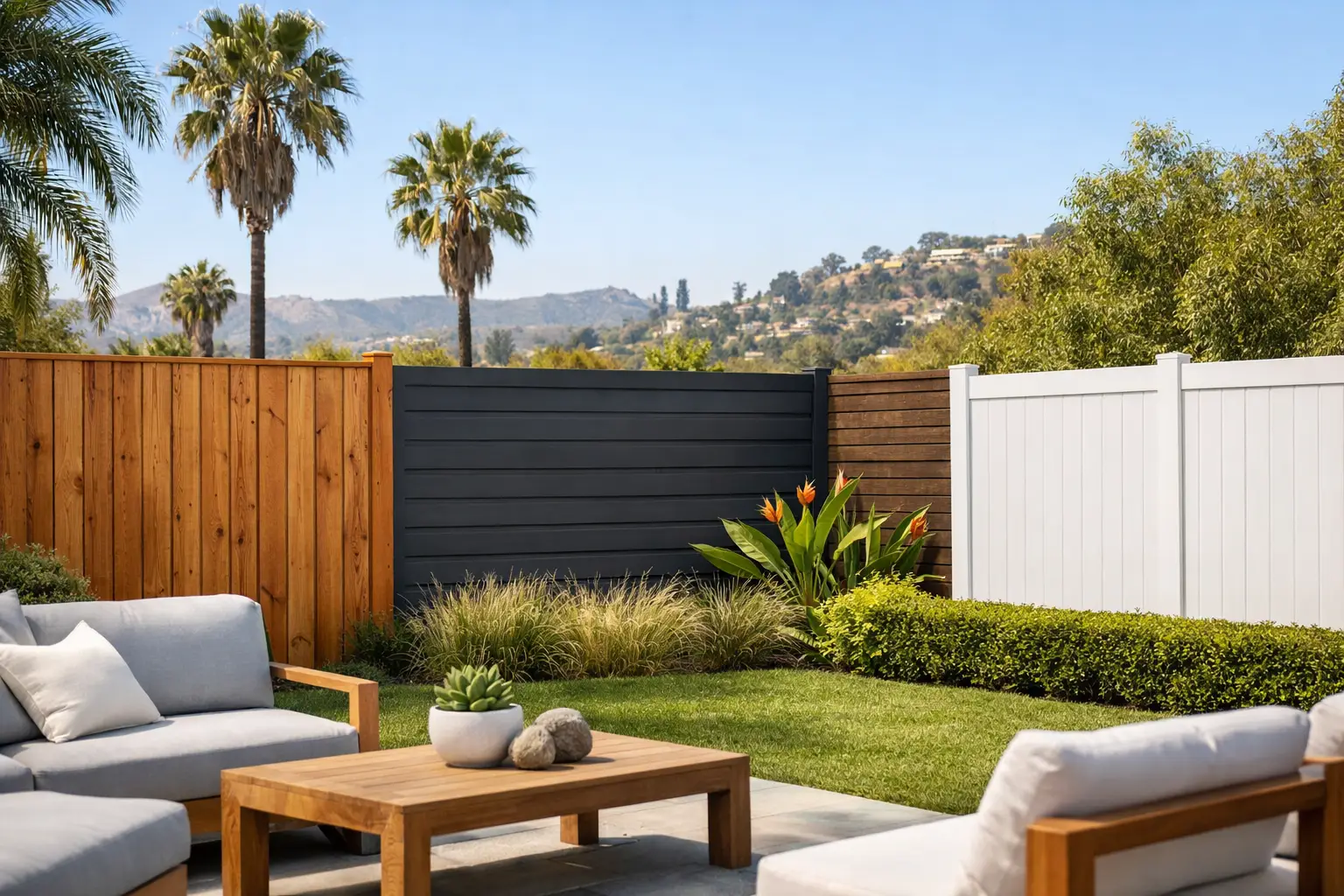
Wood remains one of the most popular choices because it can suit nearly any home style. A vertical board fence offers traditional privacy, while horizontal boards create a cleaner, more contemporary look that works particularly well with modern remodels, hardscaping, and outdoor kitchens.
Cedar and redwood are valued for their natural appearance and resistance to moisture and insects. Pressure-treated lumber can be a more budget-conscious structural option, though it requires thoughtful finishing and regular upkeep. A properly built wood fence has substantial posts, quality fasteners, drainage around the post bases, and a finish designed for Southern California sun exposure.
The trade-off is maintenance. Wood can fade, dry, split, warp, or develop surface wear over time. Staining or sealing it periodically protects the investment and keeps the color consistent. For homeowners who appreciate natural materials and want maximum design flexibility, that care is often worthwhile.
Vinyl Fences: Low-Maintenance Privacy
Vinyl fencing appeals to homeowners who want a clean, solid privacy barrier without routine painting or staining. It does not rot, and it generally cleans up with mild soap and water. White vinyl is a familiar choice, but many manufacturers offer tan, gray, and wood-look finishes that better complement contemporary exteriors.
A quality vinyl fence can perform well for years, but not all systems are equal. Thin panels may feel less substantial, and lower-grade materials can become brittle or discolor in intense sunlight. Installation matters just as much as the product itself. Properly set posts and reinforced gate openings help the fence stay aligned and functional.
Vinyl is best for homeowners who prioritize a uniform appearance and predictable maintenance. It is less ideal when a highly customized design, rich natural texture, or easy future modification is the main goal.
Composite Fencing: A Premium Wood-Look Alternative
Composite fencing combines wood fibers and recycled plastic or other engineered materials to create a low-maintenance privacy solution with more texture than standard vinyl. It is available in a range of colors, often with the look of stained wood, and can be an attractive fit for upgraded outdoor living spaces.
Its biggest advantages are durability and reduced upkeep. Composite does not need the same regular sealing schedule as natural wood, and it is less vulnerable to rot and insect damage. It also tends to retain a more polished appearance over time.
The upfront cost is usually higher than a basic wood fence, and some systems have more limited panel sizes or design options. Still, for homeowners investing in a full backyard transformation, composite can make sense when long-term appearance and low maintenance justify the initial spend.
Metal Fencing: Strong Lines With Selective Privacy
Aluminum, steel, and wrought-iron-style fencing are strong choices when visibility, security, and architectural detail matter. On their own, open metal pickets do not provide full privacy. They work best around pools, along view-facing boundaries, or in front-yard applications where a heavy solid wall would feel too imposing.
Metal becomes a privacy solution when paired with solid infill panels, horizontal wood or composite slats, decorative screens, or dense planting. This mixed-material approach can look refined while allowing airflow and preventing the yard from feeling closed off.
Steel offers a particularly bold, modern look but needs a durable protective finish to resist corrosion. Aluminum is lighter and naturally rust-resistant, making it a practical option in many residential applications. Gates should be designed as carefully as the fence itself, since a sagging or poorly aligned gate can undermine an otherwise excellent installation.
Masonry and Stucco Walls: Maximum Separation
For noise reduction, security, and complete visual separation, masonry walls are among the strongest backyard privacy fence options. Concrete block, stucco-finished walls, and stone-clad structures can complement Spanish, Mediterranean, contemporary, and custom homes throughout the San Fernando Valley.
A masonry wall can provide a more permanent feeling than a typical fence, particularly beside a busy street or between closely spaced homes. It can also incorporate planters, lighting, built-in seating, and gates for a complete hardscape design.
This option comes with higher construction costs and more planning. Footings, drainage, structural requirements, wall height, and permits all need careful attention. Because masonry is less forgiving to change later, it is worth investing in a design that works with future landscaping, renovation plans, and property access needs.
Make the Fence Work With the Rest of the Yard
The most successful privacy projects consider the entire exterior, not only the boundary line. A plain fence can become a finished backyard feature with layered planting, uplighting, trellises, or a contrasting gate. Tall, narrow plants can soften a solid fence without consuming much usable space, while climbing vines can add coverage where they are manageable and appropriate.
If your home has a new patio, pergola, pool area, outdoor kitchen, or ADU, repeat materials or colors from those elements in the fence design. For example, horizontal wood accents can tie into a pergola, while a charcoal metal frame can echo window trim or exterior lighting. These details help the improvement feel integrated rather than pieced together.
Privacy should not come at the expense of airflow, drainage, or neighbor relationships. Leave appropriate gaps where site conditions require them, avoid directing runoff toward adjoining properties, and discuss shared boundary work before construction begins. Confirm the actual property line rather than assuming an existing fence is correctly placed.
Plan for Budget, Maintenance, and Installation Quality
Fence pricing varies significantly based on linear footage, demolition, access, grade changes, gate count, material selection, post depth, and finishing details. A long, level run of standard wood fencing costs very differently from a stepped composite fence on a hillside lot with custom gates and retaining-wall coordination.
It is tempting to compare estimates only by price per foot, but that can hide meaningful differences in craftsmanship. Ask what is included for post setting, framing, hardware, demolition, haul-away, staining or painting, and gate construction. A privacy fence is exposed to sun, wind, irrigation, and daily use, so the structure behind the visible panels matters.
At WeFiks, fencing can be planned alongside hardscaping, landscaping, garage conversions, ADUs, and exterior renovation work, helping homeowners avoid mismatched materials or costly rework later. A coordinated design-build approach is especially valuable when the fence must connect to new paving, walls, drainage, or outdoor living features.
A well-chosen privacy fence gives you more than a boundary. It gives your household a place to relax, host, garden, and enjoy the outdoors with fewer compromises. Begin with the view you want to create from inside your home and from the spaces where your family spends the most time, then build the solution around that experience.